- Published on
Designing a Memory Architecture for Multi-Agent Systems
Table of Contents
- Reference architecture (at a glance)
- 0. First principles
- 1. Decide the topology: local, shared, or hybrid
- 2. Make tenancy/user isolation structural
- 3. Separate short-term from long-term memory
- 4. The short→long pipeline and the maturation gate
- 5. Retrieval: read the applied view, then clamp it
- 6. Consistency: reject last-writer-wins
- 7. Design against the four failure modes
- 8. Protect memory contents
- 9. Make it inspectable and correctable
- 10. Keep storage behind a seam
- 11. A build checklist
- Appendix: selected references
A practical guide. Distilled from a production build, written to be reusable across domains.
Memory is what turns a set of LLM calls into a system — agents that stay consistent, coordinate, and improve with use. In a multi-agent system (MAS) this is harder than it looks: memory becomes shared infrastructure, and shared infrastructure has failure modes single-agent memory never faces (leakage across users, stale beliefs, contradictory writes, lost provenance). This doc lays out a concrete, opinionated way to design one.
It is organized as a series of decisions. For each: the choice, why, and how to implement it so the guarantee is structural rather than a matter of discipline.
Reference architecture (at a glance)
A generic layout of the pieces this guide builds. A user interacts through an orchestration entry point; agents run behind a governance harness that mediates every data read, memory access, and emit; the memory layer turns short-term events into matured long-term knowledge and serves it back.
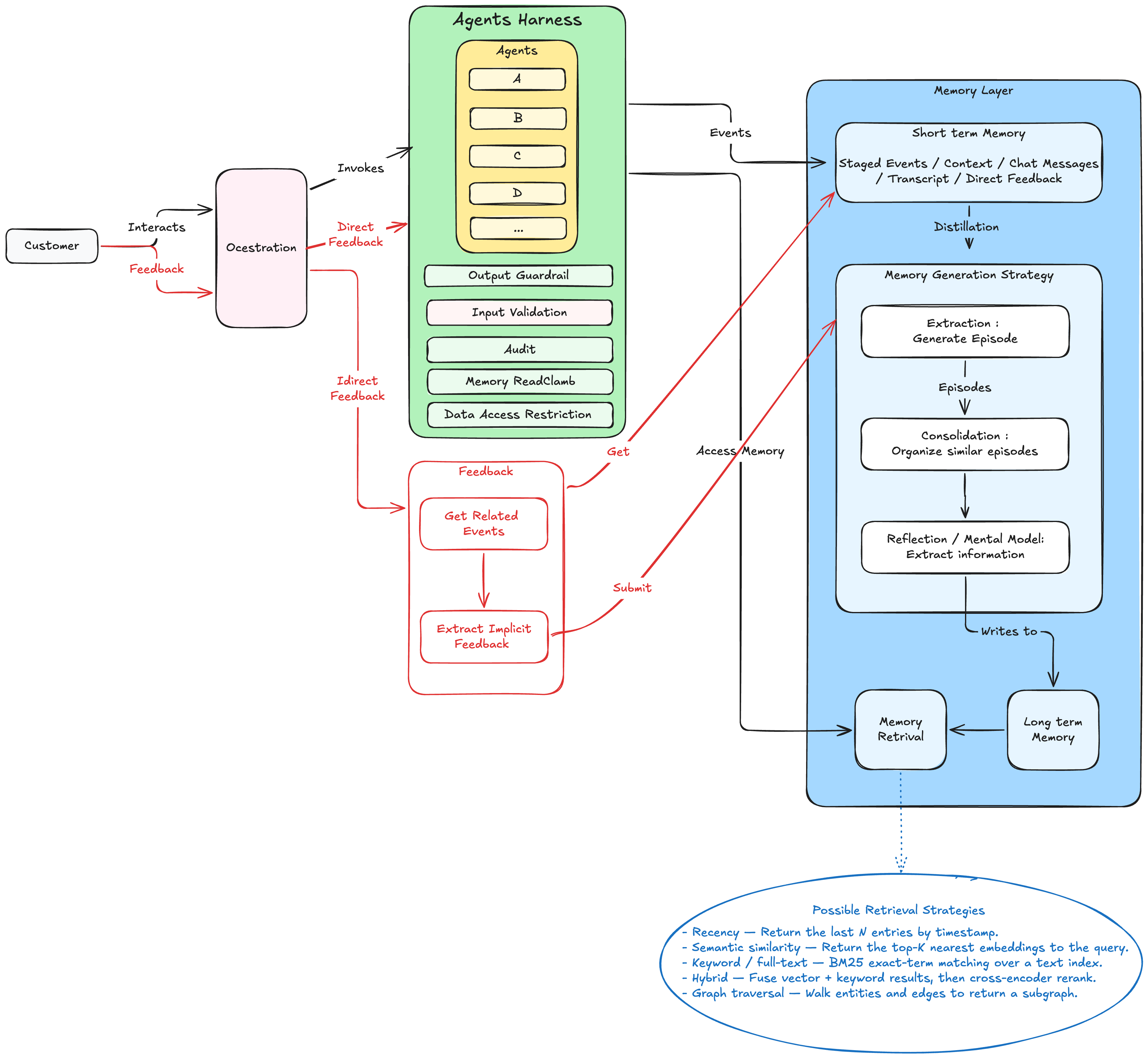
Reading it: the user talks to orchestration; agents sit inside a harness that is the single path to data, memory, and output (so nothing bypasses governance); short-term events are distilled through the draft→merge→synthesis pipeline into long-term memory; retrieval serves matured knowledge back to the agents. The dotted callouts list interchangeable generation and retrieval strategies — pick per use case.
0. First principles
Four principles drive every decision below:
- Isolation by construction, not by policy. A tenant/user boundary that depends on every caller "remembering to check" will eventually leak. Make the boundary a property of how objects are built, so the wrong access can't even be expressed.
- Learn behavior, not raw content. Long-term memory should hold how the user/agents work — preferences, patterns, process — not the sensitive payloads they work on. Re-fetch sensitive data from its system of record at use time.
- Nothing is applied until it's earned. A single observation is a hypothesis, not a belief. Gate what influences output behind repeated, recent, consistent evidence.
- Every write is attributable and reversible. Who wrote it, when, why, and what it superseded — or you can't debug, audit, or roll back a bad memory.
1. Decide the topology: local, shared, or hybrid
Three options, and the answer is almost always the third.
- Local-only — each agent keeps private memory, agents exchange via messages. Simple, isolated, but knowledge gets duplicated and agents drift out of sync (communication cost grows ~O(N²) with agent count).
- Shared-only — one global store all agents read/write. Great for coordination ("team mind"), but becomes a noisy commons and, worse, erases access distinctions — every agent sees everything.
- Hybrid (recommended) — a shared store for higher-level knowledge plus per-agent private memory. An orchestrator/coordinator (or a shared service) owns the common view; each worker keeps its own task-specific learnings.
Why hybrid wins: it gives you collective intelligence (agents personalize off a common understanding) without the noise or the access-control problems of a fully shared store. It is the consensus pattern across the recent literature.
Concretely, split memory into two tiers:
- Central shared memory — a consolidated profile/understanding every agent reads and contributes to.
- Personal per-agent memory — each agent's own learned rules, read/written only by that agent.
Route both through one API (call it a Memory Hub) so the shared policy — scoping, maturation, redaction — is implemented once, not re-implemented per agent.
2. Make tenancy/user isolation structural
This is the single most important safety decision. Do not let a caller pass in the identity of the data it wants.
Pattern: namespaces by construction. Derive every namespace from the authenticated context, inside the memory layer. Expose memory by a logical kind (a profile, a set of preferences, an activity log, …), never by a raw namespace string.
A namespace has two parts: where the memory lives (the scope, built from who's authenticated) and what it is (the kind).
[ who you are ] / [ what kind of memory ] / [ optional: which agent or session ]
- The "who you are" part is filled in by the memory layer from the authenticated session — the caller never provides it.
- The "what kind" part is chosen from a fixed list of logical stores (a shared profile, an agent's private preferences, an activity log, a shared team scope, …).
- The optional last part (an agent name or session id) just narrows things down inside the space you already own.
For example, a memory address might read as:
"this principal's shared profile" or "this principal's saved preferences for the coding agent" or "the team's shared notes."
The important part is who builds each piece — the caller never gets to name someone else's memory.
Key properties:
- There is no way for a caller to say "give me someone else's memory" — the identity part is never an argument, so another principal's address can't even be built.
- The optional narrowing parts are validated as safe tokens (no
/, no..) so they can't escape your own space. - Defence in depth: re-verify every record the backend returns is in-scope, and refuse (fail-closed) any that isn't. Reads only ever target your own namespaces, so this fires only if a shared backend misbehaves — and when it would, you refuse rather than leak.
The payoff: "cross-tenant access is impossible" becomes a statement about the type system, not about reviewer vigilance.
3. Separate short-term from long-term memory
- Short-term / working memory — the live task context: the running transcript/conversation, staged intermediate results, a session summary. High-churn, cheap, discarded or rolled up at session end. This tier may hold sensitive payloads transiently.
- Long-term memory — strategy-derived records that survive the session: preferences, profile, learned patterns, episodic history. Only behavioral / preference / process knowledge — never raw sensitive content.
The boundary between them is the maturation pipeline (next section). Short-term is where raw signal lives; only distilled, de-identified, earned knowledge crosses into long-term.
4. The short→long pipeline and the maturation gate
Don't let a single event mutate long-term beliefs directly. Run an explicit three-stage pipeline so cheap extraction is isolated from expensive consolidation, and "what we actually apply" is isolated from both:

- Draft (per event, cheap): extract candidate rules from a single event. High recall, no cross-record reasoning.
- Merge (per namespace, on write): fold drafts into existing records — dedupe, detect conflict/supersede, bump
support_count/last_seen/confidence. Use optimistic concurrency (ETag/compare-and-append) so two concurrent sessions can't clobber each other (see §6). - Synthesis (periodic / threshold): recompute status against the maturation gate, resolve contradictions recency-weighted, decay stale rules, produce the compact "applied" view agents read.
The maturation gate decides what influences output:
- PROVISIONAL — stored but not applied. A one-off never hardens.
- MATURE (applied) — enough consistent, recent support. Sensible defaults: ≥3 occurrences within 90 days.
- DECAY — no confirming signal within a TTL (e.g. 60 days) → back to provisional; past the outer window → expired. Nothing persists forever.
One useful refinement: declarative facts a principal explicitly states about themselves can establish on a single clear statement, while behavioral traits must recur. You don't repeat a stated fact every session, but you should have to demonstrate a habit before it's trusted.
Make thresholds config-tunable per agent — some agents warrant more evidence than others.
5. Retrieval: read the applied view, then clamp it
At use time an agent reads its mature personal rules bounded by shared/organizational guardrails, so a personalization can never exceed the allowed range:
personal = memory.read(kind="pref", agent=A, status="mature")
shared   = memory.read(kind="pattern", agent=A)     # org guardrails / defaults
applied  = clamp(personal, shared)                   # out-of-range prefs clamped; clamp recorded
Enforce the clamp inside the memory/governance layer, not in agent code, so no agent can apply an out-of-bounds preference. Reading status="mature" only is what keeps provisional noise out of behavior.
6. Consistency: reject last-writer-wins
Once multiple agents/sessions write concurrently, naive "last write wins" is unsafe — a weaker writer can clobber a stronger belief. Instead:
- Optimistic concurrency. Track a head revision + ETag per record; a write conditions on the etag it read. On a miss, the loser re-reads and re-merges (bounded retries). LWW is rejected.
- Append-only + head tracking. Never mutate in place; append a new revision and resolve the current head by greatest revision. This gives you history for free.
- Conflict resolution by role/confidence/recency, not arrival order. For single-valued facts, a new value supersedes the old (recency-weighted); for multi-valued, both can coexist.
- Serialize or publish/subscribe shared-state updates so agents don't reason on stale beliefs. Turn-taking is the simplest; pub/sub ("when the plan changes, subscribers refresh") scales better.
7. Design against the four failure modes
Shared MAS memory has four canonical failure modes. Design each guard explicitly and you can audit the system against this table:
| Failure mode | What it looks like | Mitigation |
|---|---|---|
| Unauthorized leakage | One tenant/agent reads another's memory | Namespaces-by-construction + in-scope re-verification (§2) |
| Stale propagation | Outdated beliefs keep shaping output | Maturation decay + finite retention (§4) |
| Contradiction persistence | Conflicting entries both survive | Supersede single-valued facts; recency-weighted synthesis; no-LWW (§6) |
| Provenance collapse | Can't tell who wrote what, when, why | Append-only, head-tracked store with per-record author/support/evidence/timestamp (§6) |
8. Protect memory contents
Treat protection as enforced invariants, not documentation:
- No sensitive payloads in long-term memory. Screen every long-term write; refuse fail-closed if it carries a sensitive value or an identifier. Re-fetch sensitive data from its system of record with provenance at use time.
- Encrypt at rest, fail closed. Make encryption-at-rest a construction contract — the store cannot be built without it configured. Prefer a customer/tenant-managed key so the data owner controls key policy and can revoke (crypto-shred).
- Encrypt in transit. TLS on every hop.
- Keep memory out of logs. Never use a namespace or record content as a log key or metric dimension — log by opaque counts/decisions only.
- Finite retention. A tunable, finite horizon; expired records age out. Nothing persists forever.
- Degrade, don't fail. If memory or a strategy is unavailable, proceed unpersonalized with a stated limitation rather than failing the interaction.
9. Make it inspectable and correctable
Trust requires visibility. Expose, per belief: what the system believes, why (its supporting evidence/support count), and whether it is currently applied (mature). Let a principal (or an admin on their behalf) correct a wrong belief or reset a scope. Because the store is append-only, corrections and resets are themselves auditable.
10. Keep storage behind a seam
Put the concrete store behind a MemoryBackend interface (read(namespace, …) / write(namespace, record, …)). Everything above it — namespacing, maturation, retrieval+clamp, the hub, the governance clamp — is identical regardless of backend. This buys you three things:
- Testability. Inject an in-memory fake for unit tests; production injects the real store. Same construction path.
- Portability / residency. Swap the endpoint to run the store in a service account or in the customer's account under their key — no change above the seam.
- Credential/rotation hygiene. For long-running processes, build a fresh client per operation (re-reading rotated credentials) rather than caching one that can expire.
11. A build checklist
- Hybrid topology: one shared store + per-agent private memory, both behind one hub.
- Namespaces derived only from authenticated context; no tenant-id argument anywhere.
- In-scope re-verification on every returned record, fail-closed.
- Short-term vs long-term split; only earned, de-identified knowledge crosses over.
- Draft → merge → synthesis pipeline with a maturation gate (provisional/mature/decay).
- Declarative-vs-behavioral maturation distinction; per-agent tunable thresholds.
- Retrieval reads
status=matureand clamps to shared guardrails, enforced in the governance layer. - Optimistic concurrency (no LWW); append-only + head tracking; provenance on every record.
- The four-failure-mode audit table has a real mitigation for each row.
- Protection: PHI/PII screen, encrypt-at-rest-or-fail-closed, no-memory-in-logs, finite retention, degrade-with-limitation.
- Inspect / correct / reset surface for every belief.
- Storage behind a
MemoryBackendseam (test fake, residency swap, credential rotation).
Appendix: selected references
Directional; largely preprints, cited for framing.
- Wu & Shu (2025), Memory in LLM-based Multi-agent Systems: Mechanisms, Challenges, and Collective Intelligence (TechRxiv) — topology/placement and consistency vocabulary.
- Rezazadeh et al. (2025), Collaborative Memory: Multi-User Memory Sharing in LLM Agents with Dynamic Access Control (arXiv 2505.18279) — private/shared fragments with immutable provenance under time-evolving access.
- Governed Shared Memory for Multi-Agent LLM Systems (arXiv 2606.24535) — the four fleet-memory failure modes in §7.
- MIRIX: Multi-Agent Memory System for LLM-Based Agents (arXiv 2507.07957) — a typed memory-store taxonomy.
- G-Memory: Tracing Hierarchical Memory for Multi-Agent Systems (arXiv 2506.07398, NeurIPS 2025) — hierarchical insight/query/interaction memory.
- Attacks, Defenses, and Governance Across the Memory Lifecycle (arXiv 2604.16548) — why writable persistent memory is a distinct threat surface.